
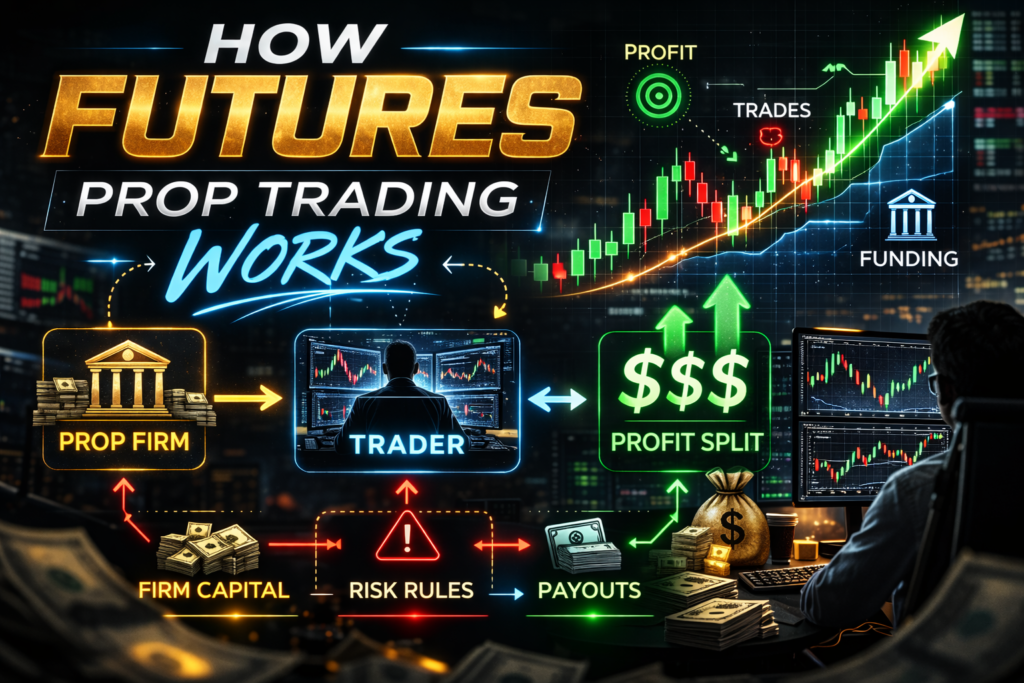
Chapter 04
How Futures Prop Trading Works
Evaluations, Funded Accounts, Rules, and How to Stop Failing for Stupid Reasons
Prop trading sounds simple on the surface:
“Pass a challenge, get funded, withdraw profits.”
But the reality is that most traders fail not because they can’t find entries, but because they don’t understand the game they are playing.
A futures prop firm is not hiring you to be a “market wizard.”
They are testing whether you can behave like a professional:
- Manage risk like a machine
- Follow rules even when emotions spike
- Trade consistently instead of gambling
- Avoid account-killing behavior under pressure
This chapter is a complete breakdown of how futures prop trading works—in real life—and how to structure your approach so you’re not one of the 80–95% who burn evaluations repeatedly.
4.1 What a futures prop firm actually is (simple and honest)
A futures prop firm is a business that provides traders access to larger capital under strict risk controls.
Their goal is not to “give free money.”
Their goal is to find traders who can generate returns without blowing up.
The prop firm model (plain English)
- You pay an evaluation fee.
- You trade a simulated or monitored environment under rules.
- If you meet requirements, you get a funded account.
- You may receive a profit split if you follow rules.
What they are really selling
Prop firms are selling opportunity + structure:
- opportunity: access to larger buying power
- structure: strict risk box that prevents disasters (and protects their business)
The structure is not optional. It is the entire product.
4.2 Evaluation vs Funded Account: what changes (and what doesn’t)
Prop traders often think funded = “freedom.”
No. Funded = “you proved you can follow rules, now follow them forever.”
4.2.1 Evaluation phase (what it tests)
Evaluations usually test:
- Can you hit a profit target without breaking risk rules?
- Can you survive drawdowns?
- Can you avoid emotional spirals?
- Can you stay consistent day-to-day?
This is not a trading IQ test.
This is a behavior test.
4.2.2 Funded phase (what it requires)
Funded trading usually requires:
- stable risk control,
- consistent execution,
- respect for daily loss limits,
- respect for drawdown rules,
- payout compliance.
If you trade funded like you traded evaluation (with pressure and desperation), you won’t last.
4.3 The 5 core rule types every futures prop firm uses
Prop firms may use different wording, but the rules almost always fall into five categories:
Rule Type 1 — Profit target
Example idea:
- “Earn $X profit to pass.”
This is the temptation rule. It makes you want to oversize.
Professional mindset:
Targets are hit by consistency, not by hero trades.
Rule Type 2 — Max daily loss (the “stop trading today” rule)
This rule sets a maximum amount you can lose in one day.
It exists because the #1 account killer is a “bad day spiral”:
- one loss → revenge trade → bigger loss → panic → account gone
Professional mindset:
Your daily max loss is your seatbelt.
Rule Type 3 — Max drawdown (often trailing)
This is usually the most confusing rule.
Max drawdown means:
- your account cannot fall below a specific line.
If it’s trailing, that line can move up when you make profits.
Professional mindset:
Trailing drawdown is not “annoying.”
It is the rule that forces you to protect gains.
Rule Type 4 — Position size limits
This is a cap on how many contracts you can hold.
It exists because traders oversize under emotion.
Professional mindset:
Your true size is not what the firm allows.
Your true size is what your risk rules allow.
Rule Type 5 — Consistency / Anti-gambling rules
Some firms restrict:
- passing with one huge day,
- earning too much in one day relative to the target,
- or require a minimum number of trading days.
They do this to avoid:
- luck-based passes,
- gamblers who will blow up funded accounts.
Professional mindset:
If you can’t be consistent, you’re not a prop trader yet.
4.4 The rule that destroys most traders: trailing drawdown (explained properly)
Trailing drawdown feels unfair to beginners because it “moves.”
But once you understand it, you stop fighting it and start using it.
4.4.1 Trailing drawdown: the concept
Imagine your account has two numbers:
- your current balance
- your “minimum allowed balance” (drawdown line)
If the drawdown is trailing, then:
- when your balance increases, your drawdown line may increase too
So profits raise the floor.
4.4.2 A step-by-step example (numbers you can visualize)
Let’s say:
- Starting balance: $50,000
- Trailing drawdown: $2,000
So your initial liquidation line is:
- $50,000 – $2,000 = $48,000
Day 1
You make $800 profit.
- Balance: $50,800
- Trailing line might move up (depending on firm rules)
Let’s say it becomes $48,800.
Day 2
You lose $700.
- Balance: $50,100
- Your trailing line stays at $48,800.
You’re still safe.
Day 3 (the trap)
You lose $1,400.
- Balance: $48,700
Now you are below the trailing line ($48,800) and the account fails—even though you started at $50,000.
This is why traders feel it’s unfair.
But it’s not unfair. It’s a system designed to stop “up big then blow it all.”
4.4.3 How professionals handle trailing drawdown
Professionals do three things:
- They reduce size after profits
Because the line is closer now. - They protect the account, not the ego
They don’t give back gains. - They trade for stability
They accept smaller wins to maintain survival.
4.5 The evaluation psychology trap (why smart traders still fail)
Evaluations create a specific emotional cocktail:
- urgency (must hit target)
- fear (must not hit drawdown)
- impatience (want it fast)
- comparison (others pass quickly)
This makes traders do dumb things:
- oversize,
- trade low-quality setups,
- break rules “just once,”
- refuse to stop after daily loss.
The truth
Evaluations are not passed by the best “strategists.”
They are passed by the best risk managers.
4.6 The 7 most common ways traders fail prop evaluations
If you avoid these, your odds improve massively:
- Oversizing to reach target faster
- Trading too many markets
- Trading during news without a plan
- Moving stops
- Revenge trading
- Overtrading after a win (“I’m hot”)
- Trying to pass in one day
Most failures are behavior failures.
4.7 The prop firm game is a “box” — learn to trade inside it
Prop rules create a box:
- max loss/day,
- max drawdown,
- max size.
Your job is to build a strategy that fits the box.
Example of a strategy that doesn’t fit
- Wide stops
- Low win rate
- High drawdowns
This fails because it violates drawdown constraints even if it’s profitable long-term.
Example of a strategy that fits
- Moderate win rate
- Tight risk control
- Smaller size
This passes because it respects rules.
Prop trading rewards controlled systems, not maximum returns.
4.8 Converting all prop rules into ticks (the professional method)
This is the step that makes everything easier.
Because you execute in the market using ticks, not dollars.
4.8.1 The conversion logic
You need:
- tick value
- rule amount in dollars
Ticks allowed = dollar rule ÷ tick value
Example
Max daily loss = $500
Tick value = $5/tick
Ticks allowed per day = 500 ÷ 5 = 100 ticks
Now you can structure your day:
- If you risk 20 ticks per trade → maximum 5 losing trades before daily stop.
This is clarity.
4.9 Building an evaluation plan that actually works (realistic and repeatable)
Most traders enter an evaluation with no plan beyond:
- “trade until I pass.”
That’s not a plan.
A real plan includes:
- setup list,
- risk limits,
- trade frequency rules,
- stop trading rules,
- daily process.
4.9.1 The “A+ setup only” approach
Pick 1–2 setups. Not 10.
Examples of setups (generic):
- breakout + retest
- trend pullback to support/resistance
- range fade at extremes
You must be able to describe your setup in one sentence and identify invalidation.
4.9.2 Risk allocation approach (simple and effective)
Set:
- Max risk per trade = 10–20% of daily max loss
- Max trades/day = 3–6 (depending on your style)
- Hard stop trading after 2 rule breaks or 2–3 consecutive losses
This stops the spiral.
4.9.3 Example evaluation plan (numbers you can copy)
Assume:
- Daily max loss = $500
- Tick value = $5/tick
So daily ticks = 100 ticks
Choose:
- Risk per trade = $75 (15 ticks)
- Max losing trades/day = floor(500/75) = 6
But you should stop earlier by behavior rule: - Stop after 3 losses → max daily loss rarely hit
Now you survive long enough for edge to play.
4.10 Funded account survival rules (how not to get funded then lose it)
Getting funded is not the goal. Staying funded is the goal.
The funded trader mindset
- Protect capital first
- Withdraw small and often (if allowed)
- Don’t “celebrate” by sizing up
- Treat every day like a business day
The funded killer
A trader gets funded, then thinks:
“Now I’ll trade bigger.”
Then they blow up in 2 days.
Professional rule:
Size increases only after a long period of stable execution.
4.11 Real-life scenarios (so it feels real, not theoretical)
Scenario 1: “The revenge spiral”
- Trader loses early
- Doubles size to recover
- Loses again
- Moves stop
- Hits daily max loss
Fix: hard limit—after 2 losses, take a break and only trade A+.
Scenario 2: “The early profit trap (trailing drawdown)”
- Trader makes $1,200 early
- Trailing line moves up
- Trader keeps trading aggressively
- Gives it back and hits the trailing line
Fix: when up big early, reduce size and protect.
Scenario 3: “The news spike”
- Trader trades during a major release
- Stop slips
- Loss is 2× expected
- Emotional shock leads to bad decisions
Fix: if you’re not specialized in news trading, don’t trade news.
Chapter 4 — Trader Tools (Original Templates)
Template 1: Rules-to-ticks conversion table
Fill this once and keep it beside you.
|
Item |
Value |
|
Market |
______ |
|
Tick value |
$______ / tick |
|
Max daily loss |
$______ |
|
Daily ticks allowed |
______ ticks |
|
Max drawdown |
$______ |
|
Drawdown ticks |
______ ticks |
|
Risk per trade |
$______ |
|
Risk per trade in ticks |
______ ticks |
|
Max contracts by rule |
______ |
Template 2: Evaluation daily plan card
- Today’s market: ______
- My A+ setup: ______
- My no-trade times: ______
- Max trades today: ______
- Risk per trade: $______
- Stop trading after: ___ losses OR ___ rule breaks
- If I’m up $____ early: reduce size to ____ contracts
Template 3: Prop-safe “mistake tracker”
The fastest way to improve is to reduce mistakes, not to chase higher win rate.
|
Mistake |
Count this week |
Plan to reduce |
|
Entered without plan |
_ |
____ |
|
Moved stop |
_ |
____ |
|
Revenge trade |
_ |
____ |
|
Oversized |
_ |
____ |
|
Traded low liquidity |
_ |
____ |
Your goal each week: mistake count goes down.
End-of-Chapter Exercise (do it now)
Choose your likely prop rules (or estimate them) and complete this:
- Max daily loss = $____
- Tick value = $____
- Daily ticks allowed = ____
- Risk per trade in ticks = ____
- Max losing trades/day by math = ____
- Your behavior-based stop rule (earlier) = stop after ____ losses
- Trailing drawdown behavior rule = when up $____, reduce size to ____
If you can answer those, you are already thinking like a professional prop trader.