
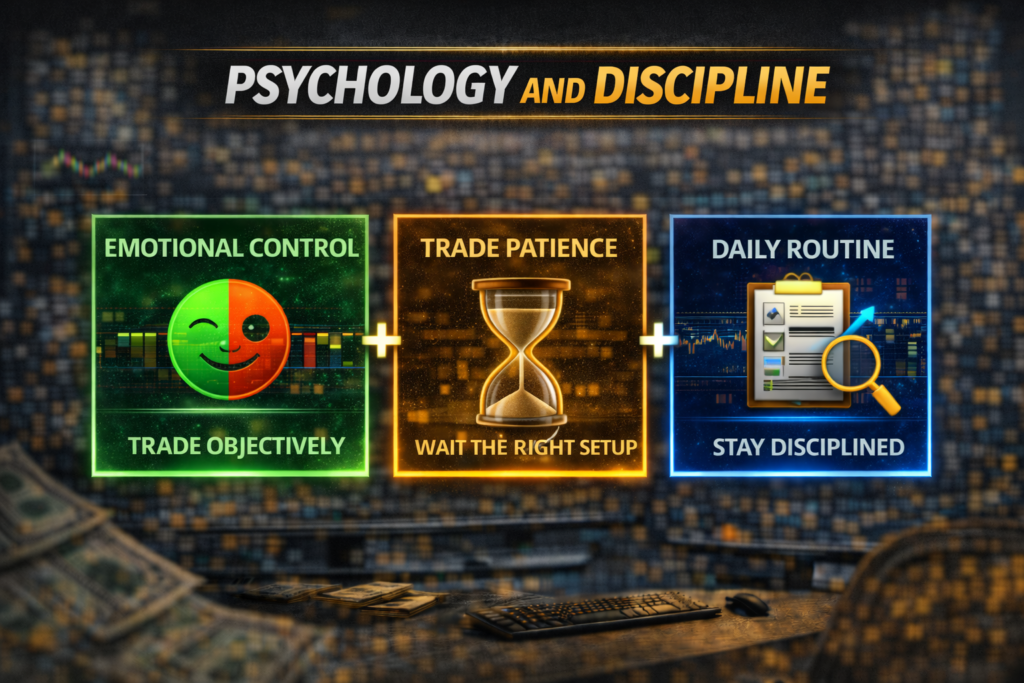
Chapter 14
Psychology and Discipline
The Real Battle: Emotion Control, Revenge Trading Prevention, Confidence vs Ego, and Building a Trader’s “Operating System”
If you’ve made it this far, you already know something important:
Trading is not mainly a technical game.
Yes, you need:
- a setup,
- a trigger,
- risk rules,
- execution skills.
But the biggest enemy is not the market.
The biggest enemy is what happens inside you when:
- you lose,
- you miss a trade,
- you’re up money,
- you’re down money,
- the market moves without you,
- you get stopped out then it reverses.
Most traders don’t fail because their strategy is “bad.”
They fail because their behavior collapses under pressure.
This chapter is your complete psychology system—practical, realistic, and designed for futures prop trading.
We’ll cover:
- The emotional cycle that destroys traders
- The 5 most common psychological “traps”
- Revenge trading: why it happens and how to stop it
- Fear vs greed vs impatience (and how each shows up on a chart)
- Confidence vs ego (and how to tell the difference)
- Building discipline through systems, not motivation
- Pre-trade and post-trade routines to stabilize your mind
- Templates you can copy to build your personal “trader operating system”
14.1 The professional truth: your emotions will always exist
Many beginners believe:
“If I become a good trader, I won’t feel fear.”
Wrong.
Professional traders still feel:
- fear,
- excitement,
- frustration,
- doubt.
The difference is:
- professionals don’t obey emotions,
- they follow systems.
Your goal is not to become emotionless.
Your goal is to become system-driven.
14.2 The emotional cycle that kills most traders (the classic loop)
Here’s the loop that destroys traders:
- Hope (I think this trade will work)
- Fear (What if I’m wrong?)
- Pain (Loss happens)
- Anger (This is unfair)
- Revenge (I’ll win it back now)
- Over-risk (Bigger size, worse entries)
- Blowup (Daily max loss or drawdown hit)
- Shame (I’m not made for this)
- Reset (New evaluation, repeat)
Most prop traders live in this loop for months.
To escape it, you need a behavior system.
14.3 The 5 most common psychological traps (and what they look like in real trading)
Trap 1: FOMO (Fear of Missing Out)
How it shows up:
- You see a move already running.
- You feel pain that you missed it.
- You enter late with poor risk.
- You get stopped out at the worst moment.
Fix:
Write this rule:
- “I only enter on my trigger, not on my feelings.”
And practice missing trades like a professional.
Missing trades is normal. Chasing trades is expensive.
Trap 2: Revenge trading
How it shows up:
- You lose a trade.
- You immediately take another trade, not because it’s good, but because you want the money back.
- You increase size or lower standards.
- You spiral into bigger losses.
Fix:
A hard rule:
- “After a loss, I must pause for 5 minutes.”
Or: - “After 2 losses, I stop trading.”
Revenge trading is not a strategy problem. It’s a nervous system problem.
Trap 3: Overconfidence after wins
How it shows up:
- You win 2–3 trades.
- You feel “in sync.”
- You size up.
- One normal loss wipes the day’s gains.
- Ego gets hurt, revenge begins.
Fix:
A pro rule:
- “Size stays constant all day.”
Or: - “Size increases only after weekly review, not intraday.”
Trap 4: Moving stops (refusing to accept you are wrong)
How it shows up:
- Price hits your stop.
- You move the stop farther.
- Loss grows.
- You panic.
- You blow the account.
Fix:
Make stop-widening a “career-ending rule break.”
Because it often is.
Trap 5: “System hopping”
How it shows up:
- You lose 2 trades.
- You assume the strategy is broken.
- You switch setups or markets.
- You never gather enough data to know what works.
Fix:
Commit to:
- one market,
- one setup,
- for 20–50 trades minimum,
before evaluating it.
Professionals judge systems by data, not by feelings.
14.4 Fear, greed, and impatience (the 3 emotions behind nearly every mistake)
Fear creates:
- early exits,
- hesitation,
- missing good entries,
- cutting winners too quickly.
Greed creates:
- holding too long,
- refusing to take profit,
- oversized positions,
- “one more trade” behavior.
Impatience creates:
- forced trades,
- entering before confirmation,
- overtrading in chop.
These emotions are normal. The fix is not “try harder.”
The fix is:
- rules,
- structure,
- routines.
14.5 Confidence vs Ego (the difference that decides your future)
This is a major turning point for traders.
14.5.1 Confidence is quiet and process-based
Confidence sounds like:
- “I followed my plan.”
- “If I lose, it’s okay.”
- “I’ll take the next A+ setup.”
Confidence is built from repetition and discipline.
14.5.2 Ego is loud and outcome-based
Ego sounds like:
- “I’m hot today.”
- “I can’t lose.”
- “I’ll pass this evaluation today.”
- “The market owes me.”
Ego is often the reason traders oversize and blow accounts.
Professional rule:
If you feel euphoric, reduce size.
Euphoria is a risk signal.
14.6 Discipline is not motivation — it is systems
Beginners rely on motivation:
- “Tomorrow I will trade perfectly.”
Motivation is unreliable.
Professionals rely on systems:
- checklists,
- hard rules,
- environment control,
- accountability.
A system works even when you feel weak.
14.7 The professional routine that stabilizes psychology
14.7.1 Pre-market psychological preparation (5–10 minutes)
Before trading:
- check news times,
- mark levels,
- write if-then plan,
- set max risk and max loss,
- remind yourself: “I only trade A+ setups.”
Then ask yourself:
- “Am I calm enough to trade?”
If not, delay trading.
14.7.2 During-market psychological control
Use these “anchors”:
- Bracket orders (removes stop hesitation)
- Max trades/day (prevents overtrading)
- Loss cooldown rule (prevents revenge)
- Timer breaks (resets nervous system)
14.7.3 Post-market decompression
After session:
- journal quickly,
- write one improvement point,
- stop thinking about trading.
Obsessing all day increases emotional sensitivity the next day.
14.8 The “recovery protocol” after a bad day (this is how pros survive)
Bad days will happen.
The difference is what you do next.
Recovery protocol:
- Stop trading immediately when daily stop hits
- Walk away (15–30 minutes minimum)
- Review only facts:
- did I follow plan?
- did I oversize?
- did I trade chop?
- Identify one mistake
- Create one fix for tomorrow
- Reduce size tomorrow (even if you “want revenge”)
This turns bad days into growth days.
14.9 Emotional hygiene: the non-trading things that affect your trading
Trading performance is affected by:
- sleep,
- hunger,
- stress,
- caffeine,
- relationship conflict,
- fear about money,
- lack of exercise.
If your life is chaotic, your trading will be chaotic.
You don’t need perfection, but you need stability.
A professional takes care of:
- sleep schedule,
- consistent meals,
- basic movement,
- a calm trading environment.
This is not “self-help.” It is performance science.
Chapter 14 — Trader Tools (Original Templates)
Template 1: The “emotion-to-action” map
|
Emotion |
Typical mistake |
Professional action |
|
FOMO |
chase entry |
wait for trigger or skip |
|
Anger |
revenge trade |
5–15 min break |
|
Fear |
exit early |
follow exit rule |
|
Euphoria |
oversize |
reduce size / stop early |
|
Boredom |
force trades |
step away |
Print this and keep it visible.
Template 2: Anti-revenge rules (choose 3 and commit)
- After any loss: 5-minute pause ✅
- After 2 consecutive losses: stop trading ✅
- Max trades/day: ____ ✅
- No re-entry within ____ minutes ✅
- Only A+ setups: list them here: ______ ✅
These rules protect your account more than any indicator.
Template 3: Discipline checklist (before every trade)
- Setup matches plan ✅/❌
- Trigger happened ✅/❌
- Stop placed ✅/❌
- Size correct ✅/❌
- I am calm ✅/❌
If any ❌ → no trade.
Template 4: Daily “trader operating system” page
Date: ______
Mood (1–10 calm): ____
Sleep quality: ____
News to avoid: ______
Key levels: ______
A+ setup: ______
Risk/trade: $____
Max loss/day: $____
Stop after ____ losses
After session:
- Rules followed %: ____%
- Biggest mistake: ______
- One fix for tomorrow: ______
This makes you consistent.
End-of-Chapter Exercise (build your personal psychology system)
Answer these honestly:
- What is your #1 emotional weakness (FOMO, revenge, fear, overconfidence)?
- What is your “stop trading” rule after losses?
- What is your maximum trades per day?
- What is your cooldown protocol after a loss?
- What is your rule for euphoria (after a big win)?
- What is your daily operating system (pre-market + post-market)?
When you write these down and follow them, you stop being a hobby trader and become a professional.