
Chapter 06
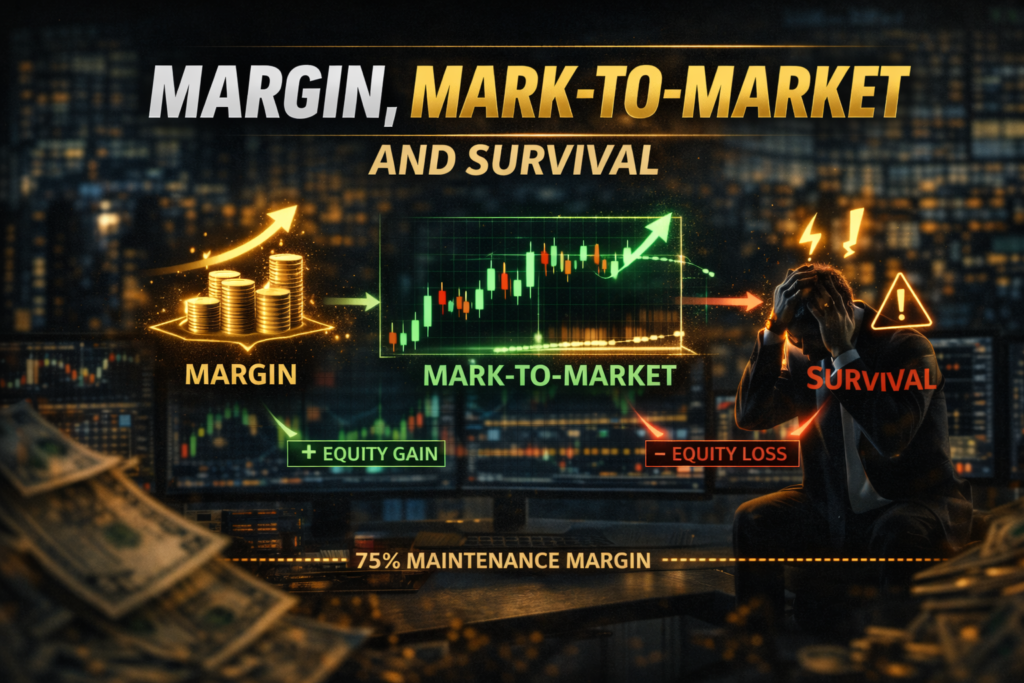
Margin, Mark-to-Market, and Survival
Chapter 6 — Margin, Mark-to-Market, and Survival
How Futures Accounts Really Work (and Why Most Traders Blow Up Without Even Realizing Why)
Most beginners think futures losses happen because of “bad entries.”
Sometimes that’s true—but far more often, futures traders blow up for a different reason:
They don’t understand the account mechanics behind the trade.
Futures is not like buying a stock and forgetting about it. Futures is a leveraged, mark-to-market system where profits and losses are recognized continuously, and where your ability to hold a position depends on whether your account meets required collateral levels.
If you understand margin and settlement properly:
- you stop oversizing,
- you stop getting “surprised” by drawdowns,
- you start trading like a professional.
This chapter will teach you:
- What margin really is (and what it is NOT)
- Initial vs maintenance margin (the difference that matters)
- Mark-to-market: why P&L updates constantly
- How margin calls actually happen
- Why volatility changes everything
- How pros structure survival rules (especially for prop trading)
- Practical templates to keep your account safe
Let’s make this simple, detailed, and real.
6.1 The single most important sentence about margin
Margin is collateral, not a down payment.
Many people wrongly imagine futures margin like:
- “I paid 5% of the contract cost, so I own it.”
No.
Margin is closer to:
- “I posted collateral to prove I can cover losses.”
This mindset change is huge because it shifts you from:
- “How much can I control?”
to: - “How much risk can I responsibly carry?”
6.2 Notional value vs margin (why futures feels powerful)
Every futures contract has a notional value (full market exposure). But you only post a fraction as margin.
Example concept (not tied to any specific contract)
- Notional exposure: $100,000
- Margin required: $5,000
This means:
- you control $100,000 exposure,
- while posting $5,000 collateral.
That is capital efficiency.
But here’s the trap:
If you treat margin as “money you can lose,” you will oversize.
Because losses can exceed the margin you posted. Margin is not a cap on loss. It is a requirement to hold the position.
6.3 Initial margin vs maintenance margin (the difference that matters)
Futures typically have two key margin levels:
6.3.1 Initial margin
This is what you need to open a position.
Think of it as:
- “the required collateral to start the trade.”
6.3.2 Maintenance margin
This is the minimum you must maintain to keep the position open.
Think of it as:
- “the minimum safety buffer.”
If your account equity drops below maintenance, the broker may:
- issue a margin call,
- liquidate positions,
- restrict trading.
Different brokers and prop firms handle this differently, but the concept is the same:
Maintenance margin is the line you don’t want to cross.
6.4 What “account equity” means in futures
Account equity is not just your cash balance. It’s typically:
Equity = cash balance + unrealized P&L
So if you are down on an open position, your equity is lower even before you close the trade.
That’s why futures feels fast: the account updates in real time.
This is also why stops matter so much.
6.5 Mark-to-market: why your P&L updates constantly
In futures, profits and losses are continuously reflected in your account, and settlements happen in a structured way.
Here is the simplest interpretation for a trader:
- If price moves in your favor, your account shows gains.
- If price moves against you, your account shows losses.
- Your account must have enough equity to support the position.
This system is what keeps futures markets stable.
But for you, it means:
- you cannot ignore losses,
- you cannot “wait it out” forever,
- you must trade inside defined risk.
6.6 How margin calls actually happen (realistic scenarios)
Many beginners think margin calls happen only when you are “stupid.”
But margin calls can happen to smart traders who don’t respect volatility and sizing.
Let’s break down the most common scenarios.
Scenario 1: Oversized position + normal market move
Trader thinks:
- “I’m using a small stop. It’s fine.”
But the market wiggles normally, hits the stop, and the loss is larger than expected because the position was too big.
Root cause:
- sizing was based on margin, not risk.
Scenario 2: No hard stop + trend against you
Trader tells themselves:
- “It’ll come back.”
Instead it trends.
Loss grows.
Equity drops.
Maintenance margin breached.
Broker liquidates.
Root cause:
- denial + no defined invalidation.
Scenario 3: News volatility + slippage
Trader places stop normally.
News hits.
Price jumps.
Stop fills worse than expected.
Loss is 2× planned.
Root cause:
- trading during events without volatility adjustment.
Scenario 4: Holding during low liquidity / off hours
Markets can move sharply when liquidity is thin.
Stops can slip.
Equity drops quickly.
Root cause:
- not understanding session liquidity.
6.7 Why volatility changes everything (and why pros reduce size)
If you learn one survival lesson, learn this:
When volatility rises, reduce size.
Volatility affects:
- stop distance needed,
- slippage probability,
- speed of P&L swings,
- emotional stability.
6.7.1 The stop size problem
In calm markets, a 10-tick stop might be reasonable.
In volatile markets, a 10-tick stop is noise.
So traders either:
- widen the stop (good), but then must reduce size (required),
or: - keep the stop tight (bad), and get chopped out repeatedly.
6.7.2 The slippage problem
High volatility increases slippage risk. Stops are not magic. They are orders that execute in the market.
During fast movement, fills can be worse than expected.
That is not “manipulation.”
That is physics: speed + liquidity.
6.7.3 The psychology problem
Your brain struggles when P&L swings rapidly.
Even good traders make dumb decisions in high volatility if they don’t reduce exposure.
So pros reduce size to keep their decision-making stable.
6.8 The hidden truth: margin requirements can change
Margin is not always fixed.
During major volatility, brokers and exchanges can increase margin requirements to protect the system. That means:
- positions that were “fine” yesterday can become more expensive to hold today.
This is rare day-to-day but happens in extreme markets.
Professional approach:
Always keep a cushion.
Never trade near the edge of margin.
6.9 Survival rules: what professionals do to stay in the game
Survival is the first skill. Profit is second.
Here are the real rules professionals follow.
Rule 1: Size by risk, not by margin
Your platform might allow 10 contracts.
Your risk plan may allow 1.
Always choose the risk plan.
Rule 2: Hard stop, always
A hard stop is non-negotiable unless you are an advanced trader with a tested alternative.
Rule 3: Daily loss limit (stop trading for the day)
This prevents emotional spirals.
Rule 4: Reduce size after losses (and sometimes after wins)
After losses:
- confidence drops,
- decision quality drops.
After wins:
- ego rises,
- risk increases.
Both can destroy you.
Rule 5: Avoid trading during chaotic periods until you are ready
News spikes and thin liquidity are advanced environments.
6.10 Futures prop trading: why margin mechanics matter even more
Prop trading adds extra constraints:
- max daily loss,
- trailing drawdown,
- max contracts.
Even if you understand margin, you can still fail a prop account if you don’t translate those constraints into your trading behavior.
Prop-safe mindset
- “My number one job is to avoid drawdown violations.”
- “I’m paid for consistency, not excitement.”
How margin and prop rules collide
If you oversize:
- even a normal pullback can hit daily max,
- and a single slippage event can hit trailing drawdown.
So funded traders typically:
- trade micros or reduced size,
- keep stops logical,
- accept small losses quickly,
- aim for stable daily gains.
6.11 Real-life examples (so you feel it)
Example 1: The “tight stop + big size” blowup
Trader wants to risk $100.
They use a 5-tick stop.
Tick value $5.
Risk per contract = 5 × $5 = $25.
They trade 4 contracts (risk = $100).
Then slippage occurs during a fast move:
- stop fills 6 ticks worse.
Now loss per contract becomes: - (5 + 6) × $5 = $55
Total loss = $55 × 4 = $220
Now the trader is angry.
They revenge trade.
Daily max loss hit.
Lesson:
- Slippage makes tight stops dangerous in fast markets.
- Oversizing magnifies slippage.
Example 2: The “no stop, it will come back” liquidation
Trader enters and price moves against them.
They refuse stop.
Loss grows.
Equity falls below maintenance.
Position liquidated at worst possible moment.
Lesson:
- No stop is not “strong mindset.”
- It’s denial.
Example 3: The professional approach
Trader risks $75 per trade.
Uses logical 15-tick stop.
Trades size that matches risk.
Stops after 2 losses.
Ends day down $150.
Lives to trade tomorrow.
Lesson:
- Survival wins the long game.
Chapter 6 — Trader Tools (Original Templates)
Template 1: Margin and safety cushion sheet
|
Item |
Value |
|
Account balance |
$______ |
|
Max risk per trade |
$______ |
|
Max loss per day |
$______ |
|
Tick value |
$______ |
|
Typical stop (ticks) |
______ |
|
Risk per contract |
$______ |
|
Contracts allowed |
______ |
|
“Cushion rule” (keep unused buffer) |
$______ |
Cushion rule suggestion:
Keep at least 30–50% of your capital/risk capacity unused while learning.
Template 2: Volatility adjustment rule
When volatility is high (big candles, fast movement, news days):
- reduce contracts by 50%
- or increase stop distance and reduce size to keep dollar risk same
|
Market condition |
Stop size |
Contracts |
|
Normal day |
Normal stop |
Normal size |
|
Volatile day |
Wider stop |
Smaller size |
|
News day |
Wider stop or no trade |
Smaller size or flat |
Template 3: Daily survival checklist
Before trading:
- I know tick value ✅/❌
- I know my max risk per trade ✅/❌
- I know my daily max loss ✅/❌
- My stop is placed ✅/❌
- I will stop after ___ losses ✅/❌
- I will not trade during ___ news ✅/❌
After trading:
- Did I follow rules? ✅/❌
- What mistake happened? ______
- What is the one fix tomorrow? ______
End-of-Chapter Exercise (this makes you dangerous—in a good way)
Answer these without guessing:
- What is margin in one sentence?
- What is the difference between initial and maintenance margin?
- If tick value is $5 and your stop is 18 ticks, what is risk per contract?
- If max risk per trade is $90, how many contracts can you trade with that stop?
- What is your daily max loss rule (the number that stops you from spiraling)?
If you can answer these correctly every day, you’re already ahead of most traders.