
Chapter 09
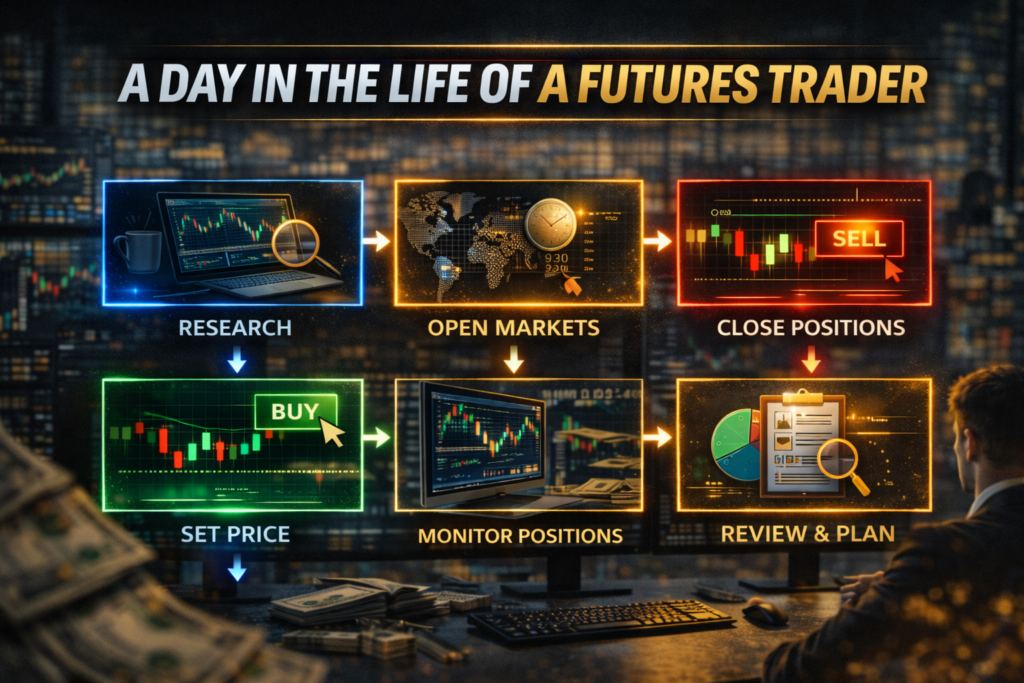
A Day in the Life of a Futures Trader
Chapter 9 — A Day in the Life of a Futures Trader
The Routine, Discipline, and “Boring Professionalism” That Makes Traders Profitable
Most beginners think successful trading looks like:
- constant action,
- fast decisions,
- nonstop trades,
- excitement and adrenaline.
That image sells courses and gets views.
Real profitable trading looks more like:
- planning,
- waiting,
- taking a few high-quality trades,
- stopping early when the day isn’t right,
- reviewing performance like a business owner.
A professional trader is not paid for activity.
A professional trader is paid for good decisions—and good decisions come from a consistent routine.
This chapter is your blueprint for:
- A realistic daily trading routine
- How to plan the day before you trade
- How pros choose “when to trade” and “when to do nothing”
- A full trade day walkthrough (good and bad)
- Journaling and review systems that create improvement
- Templates you can copy so you build a repeatable process
If you want to be funded and stay funded, this chapter is not optional.
9.1 The professional truth: most of the day is waiting
One of the hardest lessons for new traders:
You don’t get paid for being in the market. You get paid for entering at the right time with controlled risk.
Beginners overtrade because:
- they fear missing moves,
- they confuse boredom with “lack of opportunity,”
- they trade to feel productive.
Professionals understand:
- waiting is part of the job,
- not trading is often the best trade.
A pro can watch price move and do nothing—and feel proud, not frustrated—because their plan said “no setup.”
9.2 The structure of a professional trading day
A professional day is typically divided into 5 phases:
- Preparation (before trading window)
- Execution (during your chosen session)
- Risk control (daily limits enforced in real time)
- Post-trade review (same day analysis)
- Skill-building (journaling + learning + backtesting)
If you only focus on “execution,” you’re missing 80% of what creates consistency.
9.3 Pre-market preparation: the 20–40 minute routine that saves you money
You do not need a 3-hour analysis session.
You need a focused routine that creates clarity.
9.3.1 Step 1 — Check the calendar (news and volatility events)
Before anything else:
- identify major economic releases,
- identify central bank events,
- identify scheduled volatility windows.
Why?
Because news changes:
- slippage risk,
- volatility,
- stop distance needed,
- market behavior.
Beginner rule:
If you’re not a news trader, avoid trading around major releases until you’re experienced.
9.3.2 Step 2 — Identify “today’s environment”
Ask:
- Is the market trending?
- Is it in a range?
- Is volatility high or normal?
- Is it a holiday/low volume day?
You don’t need to predict the whole day. You need to classify it.
Because different environments reward different behaviors:
- Trend day → follow momentum, don’t fade everything
- Range day → fades and mean reversion often work better
- Volatile day → smaller size, fewer trades, wider stops
9.3.3 Step 3 — Mark key levels (simple, not messy)
Key levels should be obvious, not creative.
Common beginner-friendly levels:
- prior day high/low
- overnight high/low
- major swing highs/lows
- range boundaries
- opening range levels (first 15–30 minutes range)
Rule: Mark fewer levels, but higher quality.
Too many lines = confusion.
9.3.4 Step 4 — Write your “if-then” plan
Your plan should be simple:
- “If price holds above X, I look for longs.”
- “If price breaks below Y and retests, I look for shorts.”
- “If price is choppy in the middle, I do nothing.”
This prevents emotional improvisation.
9.3.5 Step 5 — Set your risk limits before the first trade
Before you trade:
- max risk per trade = $___
- max loss per day = $___
- max trades = ___
- stop trading after ___ consecutive losses
This is your seatbelt.
Professionals don’t “decide risk” after losing.
They decide it before the day begins.
9.4 Your trading window: choosing when you trade
Not all hours are equal.
Markets have times of:
- high liquidity,
- high volatility,
- low liquidity,
- chop.
You want to trade when:
- your market is most liquid,
- your setup tends to appear,
- you can focus.
9.4.1 Why “always-on trading” kills beginners
If you try to trade all day:
- you overtrade,
- your quality drops,
- your emotions build,
- you break rules.
Professional traders often trade a specific 1–3 hour window.
This keeps decision quality high.
9.4.2 The simplest trading window approach
Pick one session and commit:
- You trade your best hours.
- You stop after that window, win or lose.
This builds discipline and prevents slow mental fatigue.
9.5 Execution phase: how professionals behave during the session
This is where most accounts die—because traders get emotional.
Here are the behaviors that separate pros from beginners.
9.5.1 Professionals wait for confirmation
Beginners enter because they feel it.
Pros enter because the trigger rules say it.
Waiting feels painful.
But waiting keeps you alive.
9.5.2 Professionals do not “force trades”
A forced trade is a trade taken because:
- you’re bored,
- you’re down money,
- you want to feel active.
A forced trade is usually low quality and high emotion.
9.5.3 Professionals execute like a machine
- entry on trigger
- stop placed immediately
- target or management plan active
- no stop widening
- no impulse size changes
This is why bracket orders are so powerful in prop trading.
9.5.4 Professionals stop trading when conditions are wrong
If the market is choppy and not following your plan:
- you stop.
Not for the day forever—just until conditions return.
9.6 Risk control during the day (the rules that prevent spiral failure)
A professional trader has real-time risk rules.
These are not “ideas.” They are hard lines.
Rule A — Maximum daily loss
Once hit: stop trading.
Rule B — Consecutive losses rule
Example:
- stop after 2–3 consecutive losses.
This prevents revenge trading.
Rule C — Maximum trades/day
Example:
- max 3–6 trades/day.
Limiting trades increases quality and reduces emotional noise.
Rule D — “Emotional state” rule (advanced but powerful)
If you feel:
- anger,
- panic,
- revenge,
- desperation,
you take a break or stop trading.
Emotional trading is not trading. It’s gambling.
9.7 Full day walkthrough: “Good professional day” vs “bad beginner day”
Let’s make this real.
9.7.1 Good day (professional behavior)
Pre-market
- Trader checks news.
- Marks 3 key levels.
- Writes a simple plan.
- Sets max loss and max trades.
Session begins
- Trader waits.
- Market breaks and retests a level.
- Trader enters with bracket order.
- Trade hits target.
- Trader takes one more A+ trade only.
- Trader ends the day up modestly.
- Stops trading after session window ends.
Post-market
- Trader journals.
- Notes one improvement point.
- Moves on.
Result:
- consistent behavior,
- survival,
- slow growth.
9.7.2 Bad day (beginner behavior)
Pre-market
- No plan.
- Opens chart and “reacts.”
Session begins
- Trader enters too early.
- Stops out.
- Immediately re-enters bigger.
- Stops out again.
- Revenge trades.
- Hits daily max loss.
- Feels angry and blames the market.
Result:
- inconsistent behavior,
- emotional decisions,
- account failure.
Key difference: not strategy.
The key difference is routine and risk control.
9.8 Journaling: the part that turns you into a professional
Most traders journal incorrectly.
They write:
- “Loss. Bad market.”
That’s not journaling.
A pro journals:
- What was my setup?
- What was my trigger?
- Did I follow the plan?
- Was my stop logical?
- Was size correct?
- Did I break rules?
- What’s the fix?
Journaling is not for memory.
It’s for improvement.
9.8.1 The two things you must journal every trade
- Screenshot at entry and exit
- A reason + rule-following check
If you do just that, improvement becomes obvious.
9.8.2 Metrics pros care about
Instead of only looking at money, track:
- win rate
- average win vs average loss
- expectancy
- mistake rate
- rules-followed percentage
Money is the outcome.
Process metrics are the cause.
9.9 The “end-of-day review” (10 minutes that changes your results)
At the end of the day:
- Review your trades
- Highlight mistakes
- Pick one fix for tomorrow
- Stop thinking about trading
You don’t need 2 hours. You need consistent reflection.
Important:
Do not “revenge review.” Don’t obsess after a loss. Just learn and move on.
Chapter 9 — Trader Tools (Original Templates)
Template 1: Daily plan sheet (simple and professional)
Date: ______
Market: ______
News times to avoid: ______
Today’s environment: trend / range / volatile / slow
Key levels (max 3–5):
If-Then Plan:
- If price holds above ______, I look for ______ setups.
- If price breaks below ______, I look for ______ setups.
- If price stays in the middle/chop, I do ______ (no trade).
Risk rules:
- Max risk per trade: $______
- Max loss per day: $______
- Max trades: ______
- Stop after ______ consecutive losses.
Template 2: Trade execution checklist (before entering)
- Setup matches plan ✅/❌
- Trigger occurred ✅/❌
- Stop defined ✅/❌
- Target/management defined ✅/❌
- Size matches risk ✅/❌
- Bracket in place ✅/❌
If any ❌ → no trade.
Template 3: Journal entry (fast but effective)
|
Trade # |
Setup |
Followed rules? |
Result (R) |
Mistake |
Fix |
|
1 |
____ |
Yes/No |
_ |
____ |
____ |
|
2 |
____ |
Yes/No |
_ |
____ |
____ |
Template 4: “Stop trading” triggers (write yours)
Stop trading today if:
- I hit max daily loss ✅
- I have ___ consecutive losses ✅
- I break a rule (stop moved / oversize) ✅
- I feel revenge emotion ✅
Write this next to your screen.
End-of-Chapter Exercise (build your routine now)
Answer these:
- What is your daily trading window (start–end)?
- What are the 3 key levels you mark every day?
- What is your max risk per trade and max loss per day?
- What is your stop trading rule after consecutive losses?
- What is your journaling process (exactly what you record)?
If you can answer these clearly and follow them, you will trade like a professional even with a simple strategy.