
Chapter 08
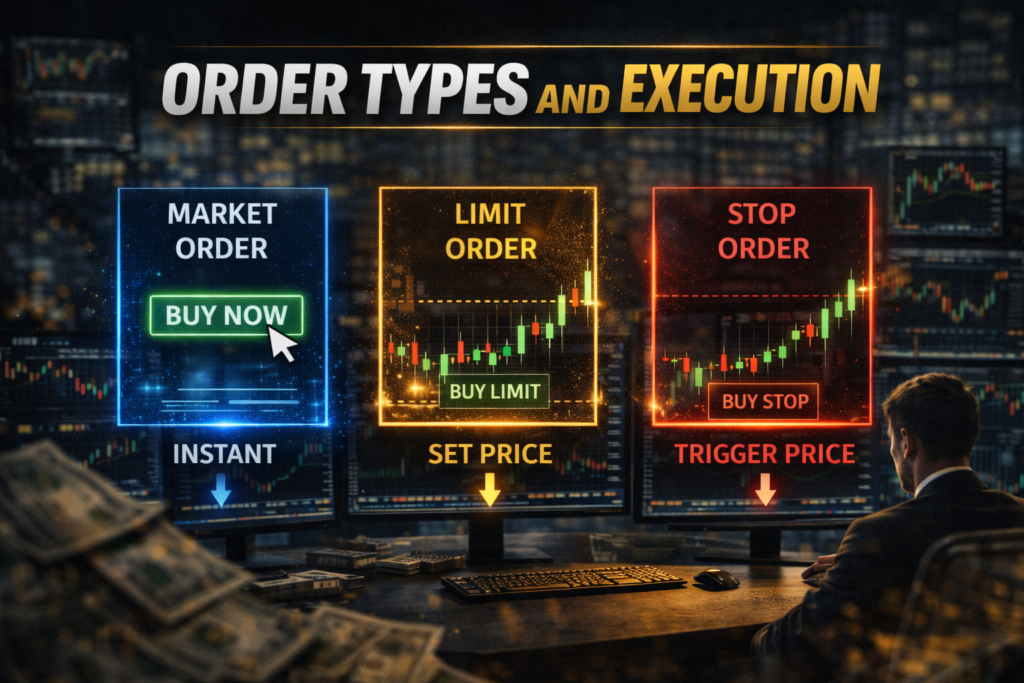
Order Types and Execution
Market, Limit, Stop, Stop-Limit, Brackets — and How Pros Stop Donating Money to Slippage
Most beginners think trading is about finding the “best strategy.”
Professionals know something more painful:
Even a good strategy fails if your execution is sloppy.
Execution is the bridge between your idea and your P&L. It includes:
- what order you use,
- where it sits,
- how it fills,
- what happens during volatility,
- how you protect yourself with stops and brackets,
- and how you avoid “getting chopped” by bad order placement.
This chapter will teach you order types like a professional—so you can stop doing the two most expensive beginner mistakes:
- Entering without a clear plan
- Managing orders emotionally after entry
We’ll cover:
- Market orders (fast but risky)
- Limit orders (precise but not guaranteed)
- Stop orders (protection + momentum entry)
- Stop-limit orders (control price, risk missing)
- Bracket orders (professional discipline tool)
- OCO/OTO logic (how bracket engines work)
- Slippage and spread (the hidden tax)
- Real scenarios and templates you can copy
8.1 The truth about orders: your strategy is only an intention
Your chart setup is an intention. Your order is the action.
Two traders can take the same setup:
- Trader A uses the wrong order type and gets terrible fills.
- Trader B uses a correct order and gets clean execution.
Same idea. Different results.
That’s why execution matters so much in futures—because tick values are fixed and costs add up quickly.
8.2 The three prices you must understand (even before order types)
Before we talk about orders, you must understand how prices appear:
8.2.1 Bid
The price buyers are currently willing to pay.
8.2.2 Ask (offer)
The price sellers are currently willing to accept.
8.2.3 Last traded price
The most recent transaction price.
The difference between bid and ask is the spread.
Important beginner reality:
- If you buy at market, you typically buy at the ask.
- If you sell at market, you typically sell at the bid.
So you often “pay the spread” when entering and exiting.
In liquid markets the spread is small, but it still exists, and it matters—especially for scalpers.
8.3 Market orders (fast execution, less control)
A market order means:
“Fill me now at the best available price.”
8.3.1 When market orders are useful
Market orders are best when:
- you need immediate entry (breakouts),
- the market is liquid,
- spreads are tight,
- you can tolerate small slippage.
Examples:
- Momentum breakout where waiting for a limit fill risks missing the move
- Emergency exit when you must flatten quickly
8.3.2 The danger of market orders: slippage
In fast markets, your market order can fill worse than you expect.
This is slippage:
- you click buy,
- price moves,
- you get filled at a worse level.
Why slippage happens (simple)
- not enough liquidity at the best price
- the market moves quickly while your order is being matched
- volatility spikes (news)
Slippage is not always manipulation. Most of the time it’s just market speed + liquidity.
8.3.3 Professional rule for market orders
Market orders are a tool, not a default.
Pros often use:
- market orders for exits (when risk must be removed),
- limit orders for entries (when precision matters),
depending on strategy type.
8.4 Limit orders (price control, no fill guarantee)
A limit order means:
“Fill me at this price or better.”
If you place a buy limit below current price:
- you’re saying “I only want to buy if it comes down to me.”
If you place a sell limit above current price:
- you’re saying “I only want to sell if it comes up to me.”
8.4.1 When limit orders are useful
Limit orders are best when:
- you trade pullbacks,
- you want precision,
- you accept missing trades.
Examples:
- Buying support in a trend pullback
- Selling resistance in a range
8.4.2 The danger of limit orders: missed fills
The market can touch your level and still not fill you, depending on:
- queue position,
- speed,
- liquidity.
Beginners often rage about:
“It touched my price and didn’t fill!”
That can happen because:
- orders are matched in sequence,
- there may not be enough volume to fill all orders at that price.
8.4.3 Professional rule for limit orders
If your strategy depends on limits, you must accept:
- sometimes you’ll miss trades,
- missing trades is better than chasing bad entries.
8.5 Stop orders (protection and momentum entry)
Stop orders are misunderstood by many beginners.
A stop order becomes active when price reaches a stop level. Often, once triggered, it becomes a market order (depending on order type).
There are two common uses:
Use 1: Stop-loss protection
- If you are long, you place a sell stop below price.
- If you are short, you place a buy stop above price.
Use 2: Momentum entry (stop-entry)
- If you want to buy only when price breaks above a level, you place a buy stop above.
- If you want to sell only when price breaks below a level, you place a sell stop below.
8.5.1 The stop-loss truth (important)
A stop-loss is not a guarantee of a perfect fill.
It’s a trigger to exit.
In fast markets, you may get slippage.
That’s why pros:
- avoid trading through extreme news unless specialized,
- size smaller in volatile periods.
8.6 Stop-limit orders (control price, but risk not getting out)
Stop-limit is a hybrid:
- it triggers like a stop order,
- but instead of becoming a market order, it becomes a limit order.
Meaning:
- you control the worst acceptable price,
- but you might not get filled at all.
8.6.1 When stop-limit can be useful
Stop-limit can be useful for entries:
- you want breakout confirmation but want to control entry price.
8.6.2 Why stop-limit can be dangerous for stop-loss exits
A stop-loss stop-limit might not fill during a fast drop:
- price gaps through your limit level,
- your order sits unfilled,
- losses grow.
Beginner rule:
For stop-loss exits, standard stop market is usually safer than stop-limit (because getting out matters more than price precision).
8.7 Bracket orders (the professional discipline weapon)
Bracket orders are one of the best tools for beginners and prop traders.
A bracket means:
- you enter a trade,
- and automatically attach:
- a stop-loss order
- a profit target order
Usually the bracket uses OCO logic:
- One Cancels the Other
If your target hits, the stop is canceled.
If your stop hits, the target is canceled.
8.7.1 Why brackets are powerful
They protect you from:
- forgetting to place a stop
- refusing to exit because “it will come back”
- emotional changes mid-trade
Brackets turn trading into a process instead of a drama.
8.7.2 The prop trader’s best friend
Prop rules punish drawdowns.
Brackets protect you from accidental risk explosions.
8.8 OCO and OTO (how advanced order logic works)
Even if you never program orders, you should understand the logic.
OCO — One Cancels the Other
Two orders exist; if one fills, the other cancels.
OTO — One Triggers the Other
An entry fills, and then your stop/target are placed.
Most bracket systems are OTO + OCO combined:
- entry triggers placement of stop/target,
- stop and target cancel each other when one fills.
8.9 Slippage: the hidden tax that ruins strategies
If you want to trade professionally, you must respect slippage.
8.9.1 When slippage increases
Slippage tends to increase during:
- major news releases
- sudden volatility spikes
- low liquidity hours
- market open/close rush
- large position size relative to liquidity
8.9.2 How to reduce slippage (practical)
- Trade liquid contracts
- Trade during active sessions
- Use limit entries when possible
- Avoid major news until experienced
- Reduce size during volatility
- Don’t put stops in obvious “stop pools” (more on that in later psychology chapters)
Slippage cannot be eliminated, only managed.
8.10 Real-life execution scenarios (so you stop guessing)
Scenario 1: Breakout trade — should you use market or stop-entry?
You see price consolidating below resistance.
You want in only if it breaks.
Professional choice:
- buy stop-entry above resistance (momentum confirmation)
- bracket with stop below breakout point
- target at next resistance
This prevents you from entering too early.
Scenario 2: Pullback trade — should you use limit?
Price is trending up and pulls back to support.
Professional choice:
- buy limit at support
- bracket with stop below support
- target at previous high
You might miss it, but you avoid chasing.
Scenario 3: You are wrong — should you use stop market or stop-limit?
If you need out, you need out.
Professional choice:
- stop market for exit protection (especially in fast moves)
Because not exiting is the bigger danger.
8.11 The most common order mistakes beginners make
Avoid these and you’ll instantly improve.
- Entering without a stop
- Moving stops farther away
- Placing stops too tight in volatile markets
- Using market orders in thin liquidity hours
- Using stop-limit for stop-loss and getting stuck
- Chasing missed limit fills with emotional market entries
- Not using brackets in prop evaluations
Most “bad trades” are actually “bad order decisions.”
Chapter 8 — Trader Tools (Original Templates)
Template 1: Order type decision table
|
Situation |
Best order type |
Why |
|
Fast breakout |
Stop-entry or market |
Confirmation + speed |
|
Pullback entry |
Limit |
Precision |
|
Protective exit |
Stop market |
Must exit |
|
Target exit |
Limit |
Price control |
|
Prop discipline |
Bracket |
Removes emotion |
Template 2: Bracket setup card (fill before session)
- Market: ______
- Entry type: market / limit / stop-entry
- Entry price: ______
- Stop price: ______
- Target price: ______
- Stop ticks: ______
- Target ticks: ______
- Risk per contract: $______
- Contracts: ______
- Daily max loss: $______
- Stop trading after: ______
Template 3: Slippage risk checklist
Before you trade, ask:
- Is there major news in the next 15 minutes? ✅/❌
- Is liquidity strong right now (tight spread)? ✅/❌
- Is the market moving unusually fast? ✅/❌
- Am I trading bigger than usual? ✅/❌
If you answered “yes” to 2+ risk items:
- reduce size or skip the trade.
End-of-Chapter Exercise (this will upgrade your execution instantly)
Answer these in your own words:
- What is the difference between a market order and a limit order?
- What is the difference between a stop order and a stop-limit order?
- Why are bracket orders so useful for prop trading?
- List 3 situations where slippage becomes dangerous.
- Create a bracket plan for your next trade (entry, stop, target, size).
If you can do this without confusion, you are already ahead of most traders.