
Chapter 11
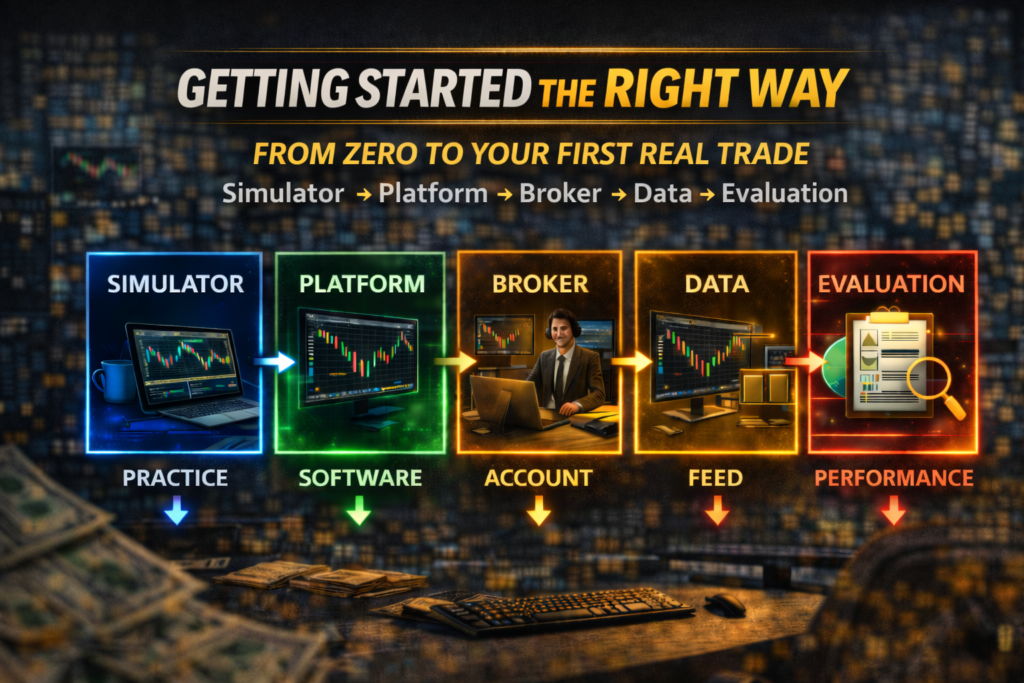
Getting Started the Right Way
Chapter 11 — Getting Started the Right Way
From Zero to Your First Real Trade: Simulator → Platform → Broker → Data → Evaluation (Without Wasting Months)
Most beginners make the same mistake when they start futures trading:
They rush into “real money mode” before building a system.
They do this because they want:
- fast progress,
- excitement,
- proof that they’re “serious.”
But the market does not reward seriousness.
The market rewards preparedness.
This chapter is your complete roadmap for getting started the professional way—especially if your goal is futures prop trading.
We’ll cover:
- The correct learning path (simulation → small size → evaluation)
- How to choose a market and a platform setup
- Brokers, data, and the hidden costs beginners ignore
- How to build your workspace like a professional (without overcomplication)
- The “first 30 days plan” that creates real skill
- Journaling and metrics that keep you improving
- Templates and checklists you can follow step-by-step
11.1 The correct path: stop trying to skip steps
Here’s the most reliable path for almost every successful trader:
- Learn the contract mechanics (tick value, sessions, volatility)
- Trade in simulation until execution is clean
- Trade small size (micros or 1 contract) to test psychology
- Enter an evaluation only when you can follow rules consistently
- Get funded and trade like a risk manager, not a gambler
Beginners want to jump from Step 1 to Step 4.
That’s why most fail.
11.2 Step 1: choose your first market (and don’t change it every week)
If you already followed Chapter 7:
- you know why one-market mastery matters.
Now you apply it here.
11.2.1 Beginner-friendly selection logic
Pick a market with:
- high liquidity,
- manageable volatility,
- micro contract option (if possible),
- clear session behavior.
Beginner rule:
Do not choose a market because “it moves the most.”
Choose it because it is stable and liquid.
11.2.2 The 90-day commitment rule
Commit to one market for 90 days.
You’re not marrying it forever.
You’re building familiarity.
Every time you switch, you reset your learning curve.
11.3 Step 2: simulation trading (why it’s not “fake” if you use it correctly)
Many people treat simulation like a video game:
- unlimited resets,
- no journaling,
- huge size,
- random trades.
That teaches bad habits.
Professional simulation is structured:
- you trade your real plan,
- with real risk rules,
- with real trade frequency,
- and you journal like it’s live.
11.3.1 What simulation is for
Simulation is for:
- learning order entry,
- building routine,
- testing your setup,
- practicing stop placement,
- learning market rhythm.
Simulation is not for:
- “seeing if you can make money in one day.”
11.3.2 The “sim-to-live readiness test”
You are ready to move from sim to small live when you can:
- follow risk rules for 10–20 sessions,
- stop after daily loss,
- avoid revenge trades,
- trade only A+ setups.
If you can’t do that in sim, you won’t do it in live.
11.4 Step 3: platform setup (simple beats fancy)
Beginners often overbuild their setup:
- 10 indicators,
- 7 timeframes,
- complex dashboards.
Then they can’t make decisions.
A professional beginner setup should be:
- clean,
- fast,
- repeatable.
11.4.1 The only chart elements you truly need
- Price (candles or bars)
- Volume (optional but useful)
- Key levels (prior high/low, obvious support/resistance)
- One simple method to identify trend/range (could be structure-based)
Indicators can help, but too many creates noise.
11.4.2 Timeframes (beginner-friendly approach)
Use 2 timeframes:
- A higher timeframe for context
- A lower timeframe for execution
Example concept:
- context timeframe: see trend/range
- execution timeframe: see entry triggers clearly
The goal is clarity, not complexity.
11.5 Step 4: broker + data (what beginners misunderstand)
This is where many beginners either:
- spend too much money,
- or choose the cheapest option that hurts execution.
11.5.1 What a broker does
A broker provides:
- access to the futures exchange,
- order routing,
- margin rules,
- account management.
11.5.2 What data is (and why it matters)
Market data is your price feed:
- real-time quotes,
- level 1 (bid/ask/last),
- level 2 (order book depth) depending on plan.
If your data is delayed or unstable:
- you will misread price,
- you will get confused,
- you will execute poorly.
11.5.3 Hidden costs to understand
Even if we ignore exact pricing, understand categories:
- Platform fees (charting/execution software)
- Data fees (real-time market data subscriptions)
- Exchange fees (sometimes included or separate)
- Commissions per trade
- Slippage (hidden cost)
Important:
Commissions and slippage matter more for scalpers than swing traders.
11.6 Step 5: build a “trader workspace” (so you trade like a business)
Your workspace impacts your trading quality.
You want:
- fewer distractions,
- stable internet,
- consistent environment.
11.6.1 The minimum professional environment
- stable main internet + backup (hotspot)
- one main monitor (two if possible, but not required)
- quiet trading time
- water/snack ready (avoid emotional hunger)
- phone on silent
This sounds small, but it prevents impulsive decisions.
11.6.2 The “execution readiness” checklist
Before session begins:
- platform working ✅/❌
- data connected ✅/❌
- bracket orders configured ✅/❌
- daily risk set ✅/❌
- news times known ✅/❌
If 2+ items are ❌, you don’t trade.
11.7 Step 6: when to start an evaluation (do not rush this)
Most evaluation failures happen because traders start too early.
11.7.1 Evaluation readiness criteria
You should start an evaluation only when:
- you can follow rules for at least 10 sessions in sim
- your daily loss control is consistent
- your trade count is controlled
- your journaling is consistent
- your emotions are manageable
You don’t need perfection.
But you need stability.
11.7.2 The “rule-following” metric
The biggest predictor of evaluation success:
- rules followed percentage.
Even if you’re breakeven, but you follow rules perfectly, you’re closer to success than a profitable gambler.
11.8 The first 30 days plan (the real blueprint)
Here is a structured plan you can follow.
Week 1: learn mechanics and execution
- learn tick value and contract behavior
- practice order types
- place bracket orders every trade (even in sim)
- trade small size in sim
Goal: execution comfort
Week 2: one setup only
- choose one simple setup (breakout pullback, trend pullback, range fade)
- define trigger, stop, target
- take only this setup
Goal: repeatability
Week 3: journal and reduce mistakes
- track every trade
- identify top 2 mistakes
- focus on eliminating mistakes, not increasing profit
Goal: discipline growth
Week 4: stability test
- apply daily max loss
- apply stop-after-loss rule
- limit trades/day
Goal: evaluation readiness behavior
If you follow this for 30 days, you become far more prepared than most traders.
11.9 Journaling and metrics: what to track as a beginner
Many beginners track only:
- money.
That’s a mistake.
Track:
- rules followed %
- average risk per trade
- number of trades per day
- mistake count
- R-multiples
Money becomes stable when process becomes stable.
Chapter 11 — Trader Tools (Original Templates)
Template 1: Beginner futures setup checklist
- My market: ______
- Tick value: $______
- My trading window: ______
- My A+ setup: ______
- My entry trigger: ______
- My stop rule: ______
- My target/exit rule: ______
- Risk per trade: $______
- Max loss/day: $______
- Max trades/day: ______
If you cannot fill this out, you are not ready to trade live.
Template 2: Platform + data readiness check (daily)
|
Item |
Ready? |
Notes |
|
Platform login works |
✅/❌ |
____ |
|
Data feed live |
✅/❌ |
____ |
|
Order routing tested |
✅/❌ |
____ |
|
Brackets configured |
✅/❌ |
____ |
|
News times marked |
✅/❌ |
____ |
Template 3: 30-day progress tracker
|
Week |
Focus |
Goal |
Result |
|
1 |
Execution basics |
clean entries/stops |
____ |
|
2 |
One setup |
repeatability |
____ |
|
3 |
Reduce mistakes |
fewer rule breaks |
____ |
|
4 |
Stability |
evaluation-like behavior |
____ |
Template 4: “Am I evaluation-ready?” scorecard
Score 1–5 (5 = strong)
|
Category |
Score |
|
Rule-following |
_ |
|
Emotional control |
_ |
|
Setup clarity |
_ |
|
Trade frequency control |
_ |
|
Journaling consistency |
_ |
If average is < 4, delay evaluation and keep training.
End-of-Chapter Exercise (make your plan real)
Write your plan now:
- Market you will trade for the next 90 days: ______
- Trading window: ______
- Setup you will trade: ______
- Entry trigger: ______
- Stop rule: ______
- Risk per trade: $______
- Max loss per day: $______
- Max trades/day: ______
- Journaling method: ______
If you do this and follow it, you’re no longer “trying trading.”
You’re building a trading business.