
Chapter 12
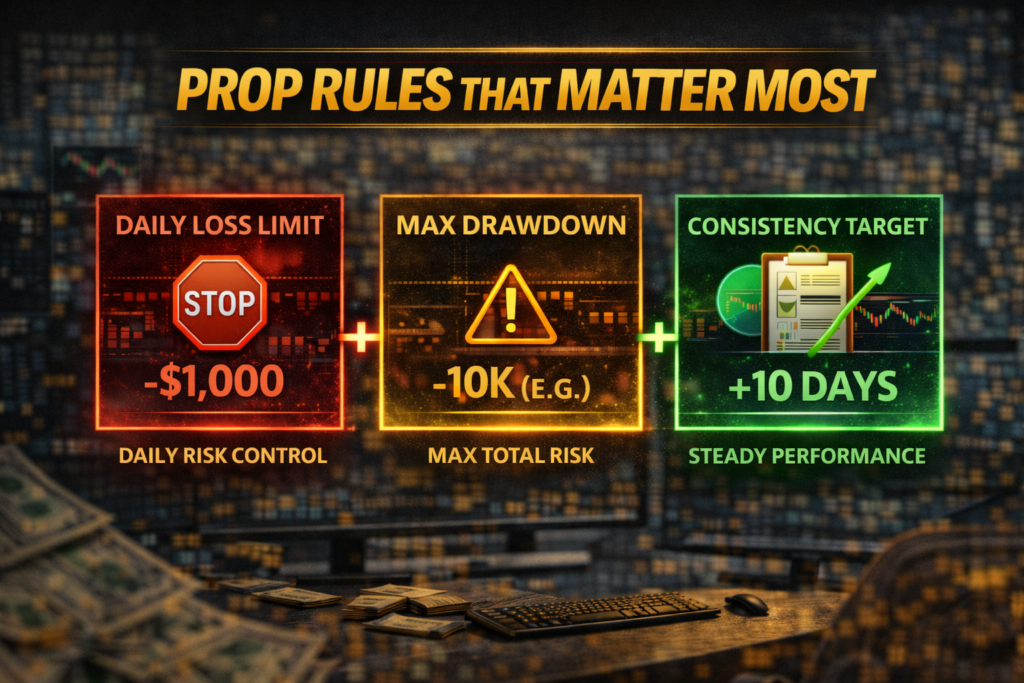
Prop Rules That Matter Most
Daily Loss Limits, Trailing Drawdown, Consistency Rules, News Restrictions, Scaling, and Payouts — Explained Like a Professional
If you want to succeed in futures prop trading, you must accept one truth:
Your strategy is not the boss. The rules are the boss.
A prop firm account is not a normal trading account where you can:
- sit through deep drawdowns,
- hold positions forever,
- size up aggressively,
- or “make it back later.”
In a prop environment, you operate inside a box. Your job is to build a system that can:
- make progress toward the target,
- while never threatening the account’s survival rules.
Most traders fail prop evaluations and funded accounts not because they don’t know chart patterns—but because they misunderstand or underestimate rules.
This chapter is a complete breakdown of the prop rules that matter most:
- Daily loss limits
- Trailing drawdown mechanics
- Max position size (contracts)
- Consistency rules (anti-gambling)
- Trading hour and news restrictions
- Scaling plans and payouts
- How to translate rules into ticks and build a “rules-safe” trading plan
- Templates you can copy to never be confused again
12.1 The purpose of prop rules (why they exist)
Prop firms aren’t trying to “trap you.” They’re doing risk control.
Rules exist to prevent three disasters:
- Traders blowing up accounts quickly
- Traders passing by luck with one huge day
- Funded traders taking reckless risk and creating unpredictable exposure
A prop firm wants:
- predictable behavior,
- controllable risk,
- consistent traders.
If you trade like a gambler, you’re not profitable for them, even if you have occasional big days.
12.2 The daily loss limit: the rule that saves you from yourself
The daily loss limit is simple:
- if you lose more than X in a day, you fail or get locked out.
It exists because most accounts are destroyed by a “bad day spiral.”
12.2.1 What causes bad day spirals
- early loss creates frustration
- frustration creates revenge trading
- revenge trading increases size and lowers quality
- losses accelerate
- daily limit is hit
- evaluation ends
The daily loss limit is designed to stop that spiral.
12.2.2 Professional way to use the daily loss limit
A pro does not trade up to the daily loss limit.
A pro sets an internal stop earlier.
Example:
- Firm daily loss limit: $500
- Pro’s personal stop: $300
Why?
Because once you’re down $300, your brain is not calm. Your quality drops.
That extra buffer protects you from emotional error.
12.2.3 Convert daily loss into ticks (required skill)
You must convert:
- daily loss dollars → daily ticks
Daily ticks allowed = daily loss ÷ tick value
Then you can set trade limits realistically.
12.3 Trailing drawdown: the rule that confuses most traders
Trailing drawdown is the most misunderstood prop rule.
It’s not just “max loss.” It’s a moving survival line.
12.3.1 What trailing drawdown is (simple)
Trailing drawdown is a “minimum allowed equity line” that can move upward as your account hits new highs.
So the more you profit, the more the minimum balance may rise.
It’s designed to prevent:
- “I made $2,000 and then blew it all.”
12.3.2 Why trailing drawdown feels unfair
Beginners think:
- “I was up big, then I gave some back, why am I failed?”
Because the drawdown line moved up when you were winning.
It’s a system that forces you to protect gains.
12.3.3 The professional response to trailing drawdown
Pros manage trailing drawdown by:
- reducing size after profits
- avoiding wild swings
- protecting equity during peak profit phases
- treating early profits like fragile capital
Key idea: The closer the trailing line is, the smaller you trade.
12.4 Max contract size: why it matters beyond “limitations”
Prop firms often cap contracts to manage exposure.
But the bigger issue is:
- traders often use the maximum allowed and blow up anyway.
12.4.1 The pro sizing rule (repeat it until it’s automatic)
You size by risk, not by max allowed contracts.
Even if the firm allows 10:
- your plan might allow 1–2.
12.4.2 Why max contracts causes emotional mistakes
Bigger size creates:
- faster P&L swings,
- faster fear,
- faster revenge trading.
If you can’t stay calm with 1 contract, you won’t magically be calm with 5.
12.5 Consistency rules: the anti-gambling system
Some prop firms include rules like:
- minimum trading days,
- no single day can exceed X% of profit target,
- or profit must be spread out.
These rules exist to filter out:
- lucky passes,
- one-day gamblers.
12.5.1 The misunderstanding
Beginners think consistency rules are “unfair.”
But firms want proof that:
- your approach is repeatable,
- not a coin flip.
12.5.2 How to pass consistency rules professionally
- aim for steady daily gains
- keep risk constant
- stop trading once you hit your daily goal
- do not chase big days
A prop trader is judged by stability.
12.6 Trading hours and news restrictions: where many traders accidentally fail
Some prop programs restrict:
- holding positions overnight,
- trading during certain hours,
- trading around major news,
- or require flat positions at certain times.
12.6.1 Why these rules exist
Because certain periods create:
- increased slippage,
- unpredictable gaps,
- volatility spikes.
These are hard to risk-manage for many traders.
12.6.2 Professional approach
If you’re not a specialized news trader:
- avoid the restricted windows entirely.
Trade when markets are “normal.”
12.7 Scaling plans and payouts: what funded traders must understand
Once funded, traders often think:
- “I’ll withdraw big and trade bigger.”
But funded accounts usually have:
- payout rules (timing, thresholds, consistency),
- scaling rules (increase size after sustained performance),
- sometimes buffer requirements.
12.7.1 Why scaling exists
Firms scale you when you show:
- control,
- consistency,
- low risk of blowing up.
Scaling rewards stability, not aggression.
12.7.2 Why payout rules matter psychologically
Payout structures can cause mistakes:
- “I just need $X more to withdraw”
- “I’ll trade bigger to reach payout threshold”
This creates gambling behavior.
Professional rule:
Treat payout goals like profit targets—don’t chase them. Follow the plan.
12.8 Build a “rules-safe” strategy (the most important part)
A rules-safe strategy has these traits:
- controlled risk per trade
- controlled trade frequency
- stops always
- limited drawdowns
- realistic targets
If your strategy requires:
- deep drawdowns,
- holding losers long,
- high volatility exposure,
it may be profitable in theory but not compatible with prop rules.
Prop trading is not “maximize returns.”
Prop trading is “maximize survivability + steady progress.”
12.9 The rule translation method (turn rules into a daily operating system)
Here’s how professionals make prop rules easy:
Step 1: Convert daily loss into ticks
Daily ticks = daily loss ÷ tick value
Step 2: Decide risk per trade in ticks
Usually 10–25% of daily ticks.
Step 3: Set max trades/day
This limits overtrading.
Step 4: Set stop-after-loss rule
Stops revenge spirals.
Step 5: Set profit cap rule
When you hit your daily goal, stop trading.
This turns prop trading into a controlled system.
Chapter 12 — Trader Tools (Original Templates)
Template 1: Prop rules conversion sheet
Fill this once and keep it next to you.
|
Rule |
Dollar value |
Tick value |
Tick equivalent |
|
Daily loss limit |
$____ |
$____/tick |
____ ticks |
|
Trailing drawdown |
$____ |
$____/tick |
____ ticks |
|
Max risk per trade |
$____ |
$____/tick |
____ ticks |
|
Daily profit goal |
$____ |
$____/tick |
____ ticks |
|
Max contracts allowed |
____ |
— |
— |
Template 2: Rules-safe daily plan
- Daily loss limit (firm): $____
- Daily loss stop (personal): $____
- Risk per trade: $____
- Risk per trade (ticks): ____
- Max trades today: ____
- Stop after ____ consecutive losses
- Stop trading when up $____
Template 3: Trailing drawdown protection rules
Write your protection rules:
- If I’m up $____, I reduce size by ____%.
- If my balance gets within $____ of the trailing line, I trade 1 contract only OR stop trading.
- I will not give back more than ____% of the day’s peak profit.
These rules prevent “up big then fail.”
Template 4: News and restriction plan
- Restricted news times: ______
- My no-trade buffer: ____ minutes before/after
- If I’m in a trade before news: I will ______ (exit / reduce / hold by tested plan)
Avoiding confusion prevents accidental violations.
End-of-Chapter Exercise (this is how you stop failing rules)
Answer these with your real prop conditions:
- What is your daily loss limit in ticks?
- What is your trailing drawdown in ticks?
- What is your risk per trade in ticks?
- How many losing trades can you take before you stop (behavior rule)?
- What is your daily profit goal and “stop trading” point?
- What is your rule for reducing size after profits?
If you can answer these, you’re no longer “hoping to pass.”
You’re running a controlled system.